Azerbaijan's Initiatives for Regional Transportation and Connectivity: A Strategic Analysis
Azerbaijan, a nation nestled between Europe and Asia, has a unique geopolitical position that renders it a vital player in regional transportation and connectivity. Over the last few decades, Azerbaijan has actively pursued strategies to enhance its role as a regional hub, leveraging its rich energy resources, modernizing infrastructure, and expanding its geopolitical influence. The initiatives undertaken by the government in transportation, logistics, and connectivity are transforming Azerbaijan into a critical junction for trade between the East and West, as well as the North and South. This article delves into Azerbaijan's major initiatives in regional transportation and connectivity, the motivations behind these efforts, and their broader implications for the region and beyond.
Geopolitical Context and Strategic Location
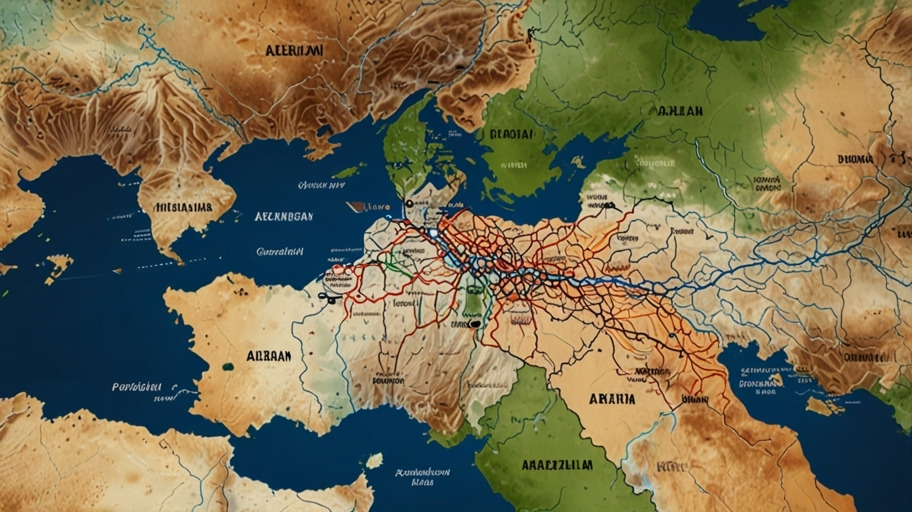
Azerbaijan's geographical positioning makes it a critical player in regional transportation networks. The country lies at the crossroads of several major regions—Eastern Europe, Central Asia, and the Middle East—giving it direct access to key trading routes. Azerbaijan's location along the Caspian Sea , bordered by Iran, Russia, and Turkey, further enhances its strategic importance.
Historically, the Silk Road, which connected Europe and Asia, passed through Azerbaijan, making it a crucial transit point for goods, culture, and ideas. In modern times, this historic relevance has translated into Azerbaijan becoming a key player in several international connectivity initiatives aimed at rejuvenating the Silk Road spirit and enhancing transcontinental trade. Additionally, the proximity of Azerbaijan to energy-rich regions, combined with its own significant oil and gas reserves, adds to its geopolitical clout.

Azerbaijan's Transportation Infrastructure Development
Over the past two decades, Azerbaijan has invested heavily in modernizing its transportation infrastructure, recognizing the role it plays in fostering economic growth, regional integration, and global trade connectivity. Key projects in this regard include the Baku-Tbilisi-Kars (BTK) railway , the expansion of the Port of Baku, and the North-South Transport Corridor (NSTC).
1. Baku-Tbilisi-Kars (BTK) Railway
The Baku-Tbilisi-Kars railway is one of the most significant projects in Azerbaijan's transportation strategy. Launched in October 2017, the BTK railway connects Azerbaijan, Georgia, and Turkey, providing a direct rail link from the Caspian Sea to Europe. This 826- kilometer railway has dramatically reduced travel time for goods between Asia and Europe, bypassing the traditional sea route through the Suez Canal.
The BTK railway is part of a broader regional initiative known as the Trans-Caspian International Transport Route (TITR), or the Middle Corridor, which aims to connect China to Europe via Central Asia, the Caspian Sea, and the South Caucasus. By facilitating faster and more efficient transportation of goods, the BTK railway strengthens Azerbaijan's position as a vital bridge between East and West.
The railway not only enhances Azerbaijan's connectivity but also bolsters its geopolitical leverage. By connecting to Turkey, a NATO member, and integrating with the European rail network, Azerbaijan positions itself as an indispensable partner in European and Asian trade networks. This is particularly important in the context of increasing geopolitical competition in the region, with powers like Russia, China, and the European Union vying for influence.
2. Port of Baku Expansion
The Port of Baku, located on the Caspian Sea, is Azerbaijan's oldest and most strategic port. Recognizing its potential to become a key hub in regional trade, the government initiated a massive modernization and expansion project in recent years. The new Baku International Sea Trade Port, located at Alat, 70 kilometers south of the capital Baku, is set to become the largest and most modern port in the Caspian region.
The Alat Port, with a capacity to handle 25 million tons of cargo and up to 1 million TEU containers annually, is a critical component of Azerbaijan's strategy to enhance its role in the East-West and North-South trade corridors. The port is strategically located at the intersection of the BTK railway and the Trans-Caspian shipping routes, making it a key node in the Middle Corridor.
Additionally, the port's Free Trade Zone (FTZ) further enhances its appeal as a logistics hub. The FTZ offers tax incentives and simplified customs procedures for companies engaged in trade and manufacturing, attracting foreign investment and promoting Azerbaijan as a regional logistics center.
3. North-South Transport Corridor (NSTC)
Another major initiative is Azerbaijan's active participation in the North-South Transport Corridor (NSTC), which aims to connect South Asia with Northern Europe via Iran, Azerbaijan, and Russia. This corridor, first conceptualized in 2000, offers a shorter and more efficient alternative to the traditional maritime routes through the Suez Canal.
Azerbaijan plays a central role in the NSTC, as the country provides the key land route for goods moving between Iran and Russia. The development of rail and road infrastructure within Azerbaijan has been essential for facilitating this corridor. The completion of the Astara-Rasht- Qazvin railway, which connects Azerbaijan's rail network to Iran, has been a significant milestone in this regard.
The NSTC has strategic implications not only for Azerbaijan but also for the broader region. For India, the NSTC offers an alternative to the China-dominated Belt and Road Initiative (BRI) for connecting with Europe. For Russia, it provides a direct link to Persian Gulf markets, while for Iran, it offers access to Northern European markets. By facilitating trade along this corridor, Azerbaijans its ties with key regional players while positioning itself as a pivotal transit country.

Azerbaijan and the Belt and Road Initiative (BRI)
Azerbaijan has also aligned itself with China's Belt and Road Initiative (BRI), a massive infrastructure and trade project aimed at connecting Asia with Europe and Africa through a network of land and sea routes. Azerbaijan's participation in the BRI, particularly through the Middle Corridor, aligns with its strategic goal of becoming a major transportation hub.
The Middle Corridor, which links China to Europe via Kazakhstan, Azerbaijan, Georgia, and Turkey, is a critical component of the BRI. Azerbaijan's involvement in this initiative offers it the opportunity to capitalize on the increasing trade flows between China and Europe. The development of infrastructure transportation, such as the BTK railway and the Port of Baku, has positioned Azerbaijan as a key transit country in this corridor.
Azerbaijan's participation in the BRI also enhances its bilateral relationship with China. In recent years, China has become an important trade partner and investor in Azerbaijan's infrastructure projects. For Azerbaijan, aligning with the BRI not only boosts its economic prospects but also offers it an opportunity to balance its relations with other regional powers, such as Russia and the European Union.
Regional Impacts of Azerbaijan's Connectivity Initiatives
Azerbaijan's ambitious transportation and connectivity projects have far-reaching implications for the region. By positioning itself as a key transit country in several international trade corridors, Azerbaijan has the potential to reshape regional trade dynamics and foster greater economic integration.
1. Economic Diversification
One of the primary motivations behind Azerbaijan's transportation initiatives is economic diversification. Azerbaijan's economy has traditionally been heavily reliant on oil and gas exports. However, fluctuations in global energy prices have underscored the need for economic diversification. By investing in transportation infrastructure and promoting itself as a regional logistics hub, Azerbaijan aims to reduce its dependence on energy exports and develop other sectors, such as transportation, logistics, and manufacturing.
The expansion of the Port of Baku and the development of free trade zones are part of this broader strategy. By attracting foreign investment and promoting trade, Azerbaijan seeks to create new economic opportunities and generate employment in non-energy sectors.
2. Strengthening Regional Integration
Azerbaijan's transportation initiatives are also aimed at fostering greater regional integration. By enhancing connectivity with neighboring countries, such as Georgia, Turkey, Russia, and Iran, Azerbaijan is playing a pivotal role in promoting regional trade and cooperation.
The development of the BTK railway and the NSTC, for example, has strengthened Azerbaijan's ties with its neighbors and facilitated the movement of goods across the region. This increased connectivity has the potential to promote greater economic cooperation and reduce trade barriers between countries in the South Caucasus, Central Asia, and beyond.
3. Enhancing Geopolitical Influence
Azerbaijan's transportation initiatives have not only economic but also geopolitical implications. By positioning itself as a key transit country in major international trade corridors, Azerbaijan enhances its strategic importance and geopolitical influence.
For Europe, Azerbaijan offers an alternative route for energy supplies and trade, reducing dependence on Russian-dominated routes. For China, Azerbaijan provides a critical link in the Belt and Road Initiative, while for Russia, Azerbaijan is a vital transit country in the North -South Transport Corridor. By playing a key role in these initiatives, Azerbaijan strengthens its relationships with major global powers and enhances its geopolitical leverage.
Conclusion
Azerbaijan's initiatives for regional transportation and connectivity are transforming the country into a vital transit hub between East and West, as well as North and South. Through the development of key infrastructure projects, such as the BTK railway, the Port of Baku, and the NSTC , Azerbaijan is enhancing its role in global trade networks and promoting regional integration. These efforts not only contribute to Azerbaijan's economic diversification but also enhance its geopolitical influence. As global trade patterns continue to evolve, Azerbaijan's strategic investments in transportation and connectivity will ensure that it remains a key player in regional and global trade for years to come